
Lackawanna County Resident Lookup Coverage
A useful one-person record check begins by matching the question to the custodian. The Assessment Database can supply a current property-owner or parcel lead. The Recorder can connect a name to a recorded transaction. A court docket can establish public case placement, while the Register of Wills can provide an estate trail. Historic vital material and local collections are better for an older family event. None of these sources is a complete list of everyone at an address.
| Record | What It Confirms | Where | Access |
|---|---|---|---|
| Assessment or tax record | Owner field, parcel, situs location, and tax-mail destination as shown. | Assessment Database and tax search. | Public search. A mailing address does not prove occupancy. |
| Recorded instrument | Named parties, document date, type, and legal-description trail. | Recorder Self Service. | Index verified from 1878 through August 27, 2026; copies follow a separate route. |
| Public court docket | Public case placement, caption, docket events, and calendar information. | Pennsylvania Judiciary Web Portal. | Restricted and sealed material is not a public-result assumption. |
| Estate or probate file | Decedent, representative, and a probate-file lead where open. | Register of Wills. | Office states its filings reach 1878; genealogy requests have their own procedure. |
| Historical vital material | Event and certificate-number leads for family research. | Pennsylvania State Archives. | Historical copies are noncertified and have distinct access periods. |
| Voter record channel | Limited registration presence through the authorized route. | Pennsylvania voter-status service and Elections. | Status lookup is not a public name or street browser. |
When a person is tied to a known parcel, begin with property records. When the only lead is a death date or family name, the estate, archive, library, or newspaper route may be more direct. The result should be treated as a record-specific fact, not a statement of current residence.
Lackawanna County Court Search Fields
The Pennsylvania Judiciary portal is the public court entry point for Lackawanna County common pleas and magisterial cases. A participant-name search is a starting point, not an identity decision. Narrow a result with a known date range, municipality, docket number, or other lawful detail that is already supported elsewhere. The portal cautions that recent filing-office entries may not appear immediately, so a no-result screen does not prove that no public record exists.
| Portal control | How it narrows a search |
|---|---|
| Participant criteria | Last and first name, date of birth, role, organization, attorney, and related fields. |
| Court criteria | County, judicial district, magisterial court, docket type, category, status, and judge. |
| Docket or date criteria | Docket number, filed-date range, offense tracking number, complaint, or incident route. |
| Property criteria | Parcel number, address, city, ZIP, state, county, and municipality where applicable. |
The Pennsylvania Judiciary Web Portal displays the public docket and calendar entry point for a name-based court search.
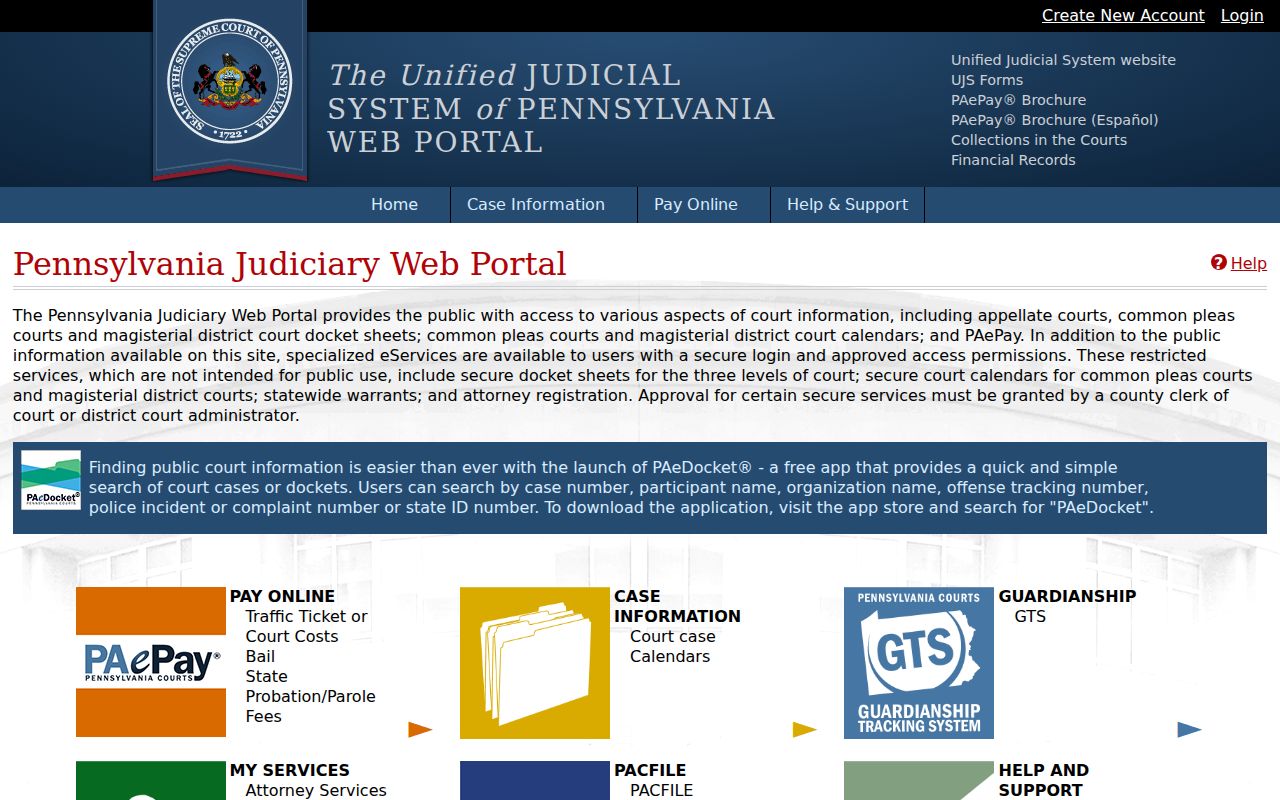
A docket can supply a court, caption, case type, filing information, and listed public entries. It is not the complete file, a certified copy, or proof that two people with the same name are one person.
Read each public result as a limited docket record rather than a broad statement about a person.
- Court placement: the Court of Common Pleas of Lackawanna County can appear on the docket sheet.
- Docket placement: the example format uses the county’s 35 designation and a case-year component.
- Case information: docket-sheet and calendar material may show public case activity, with recent-entry lag noted by the portal.
- Identity lead: participant-name searching supports a result, but the live docket must be read rather than inferred from a name match.
- Document access: public docket services are distinct from separately restricted secure services.
- Limits: sealed, juvenile, adoption, expunged, and other confidential matters remain outside a normal public name search.
Verifying a Lackawanna County Resident
Verification works best when two independent custodians agree. For a property-related name, the assessment owner field supplies a parcel and situs address. The Recorder can then be searched for that owner as a grantee, using the legal description and document date to test whether the transaction concerns the same parcel. The tax search keeps location and mailing fields separate, which is an important local distinction.
- Search the Assessment Database by owner, street address, or parcel ID. Save the parcel and situs details exactly as returned.
- Compare the current-year tax result only as a mailing clue. A post-office box, representative, business, or out-of-county address can receive tax mail.
- Search the Recorder index for the owner as grantee. Compare the document date and legal description before calling it a match.
- Use a public court docket or estate file only as a separate corroborating record, then ask the relevant custodian about copies when one is actually needed.
- Docket
- A court’s running case record, usually listing public filings and events rather than every underlying document.
- Index and image
- An index points to a record. An image is the scanned document or page, which can have a separate access or copy path.
- Certified copy
- A copy issued by the custodian with its certification process. It is different from a portal result or research copy.
Note: Retain the parcel, docket, or document number with a search note because it is more dependable than a name alone.
Lackawanna County Same-Name Checks
Names recur across decades of Lackawanna County directories, deeds, and court records. Build a small comparison grid before joining two results: spelling or initial variation, address or parcel, party role, date, court or county, and record number. A match becomes stronger when an assessment owner and a deed grantee align, or when an estate date and a historical directory address support each other.
The same address may still need explanation. The county tax interface separates the physical location from the mailing destination, and a current assessment entry is not a household list. This is the local version of a common myth: an owner name or mail address does not identify every resident of a property. Stop at a conflict rather than filling it with a guess.
Lackawanna County Resident Estate Leads
An heir question belongs first with the Register of Wills and Clerk of Orphans’ Court. The office says it preserves estate and probate filings from 1878 forward. Its genealogy form asks for a decedent name, file number when known, death date, requester details, signature, payment, and a self-addressed envelope. The stated genealogy-search fee is $25 and is nonrefundable.
An estate file can lead to a decedent, a personal representative, and a public-file reference where available. It does not automatically establish every family relationship or current address. If the relevant history predates Lackawanna County’s 1878 formation, the research trail may move to Luzerne County rather than end at the county line.
Pennsylvania Vital Records for Residents
Pennsylvania divides vital research by era and record type. The Division of Vital Records holds statewide births, deaths, and fetal deaths from 1906 forward. Modern certified records use the Department’s application, identity, payment, and eligibility rules. For older research, the State Archives holds birth originals from 1906 through 1920 and death originals from 1906 through 1975, with noncertified copies. Birth records become public after 105 years and death records after 50 years under 35 P.S. § 450.807.
The Pennsylvania Vital Records forms page provides the current official application routes for a name-linked vital request.
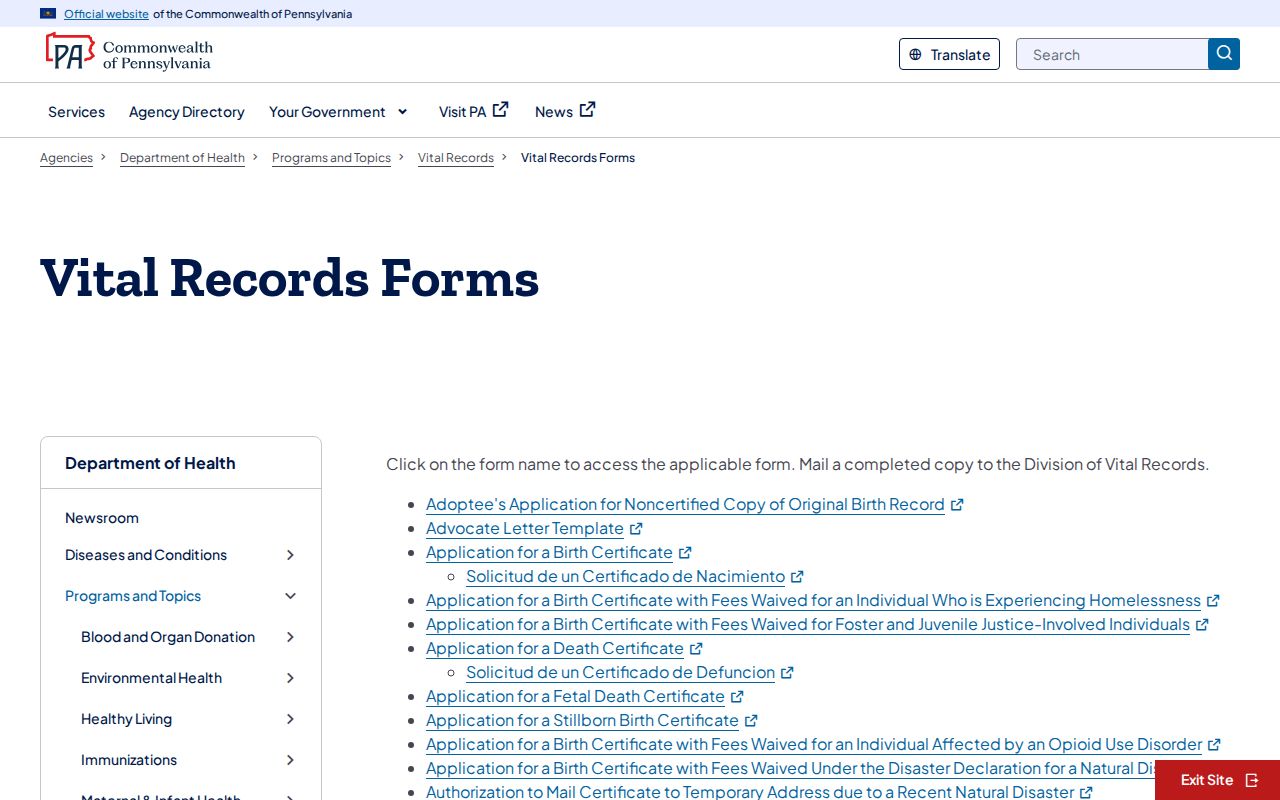
For a birth application, the Department captures the applicant’s name and contact details, relationship to the named person, available event details, identity documentation, fee and quantity, plus signature and date. Mail, official online, and public-office channels are documented; timing should be checked when ordering.
The Pennsylvania Division of Vital Records is the statewide custodian for modern certificate routes.
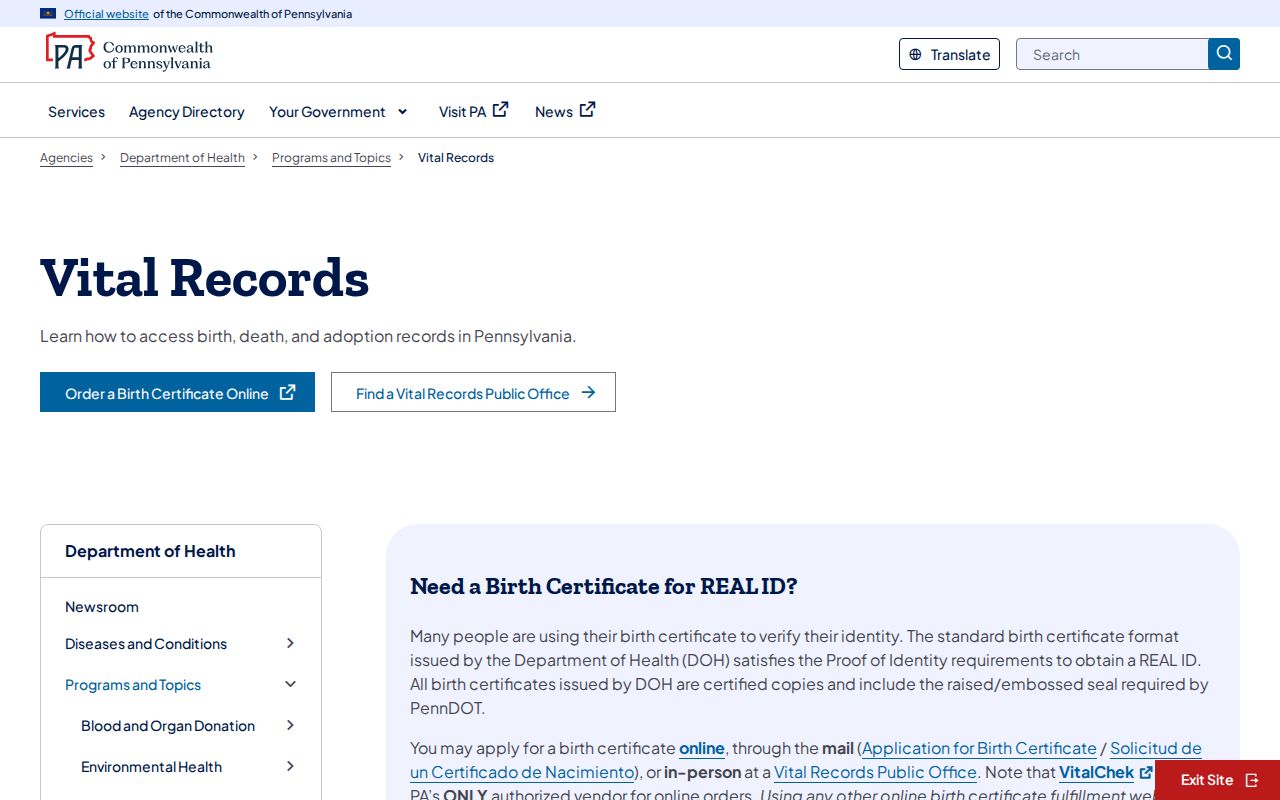
Scranton births and deaths from 1878 through 1905 have a local microfilm route through the County Library System, while deaths outside Scranton from 1893 through 1905 are directed to the Register of Wills. A state 1906 search therefore should not erase an older local path.
Pennsylvania Adoption Information Routes
Adoption information is not a public name-index project. Pennsylvania’s official adoption routes include an eligible adoptee’s application for a noncertified original birth record and the Pennsylvania Adoption Information Registry, known as PAIR, for medical and social history, contact preferences, and release paths. Lackawanna County Orphans’ Court information also describes a petition route for certain identifying or nonidentifying family-information requests, subject to consent and processing limits.
Use the current Department of Health forms and the appropriate court procedure. Those controlled channels protect people whose information cannot be obtained through an ordinary name search.
Lackawanna County Resident Voter Limits
The state’s voter-status tool is for a voter to check registration status. It is not a public browse-by-name or browse-by-address directory. Pennsylvania Election Code Section 1404 instead governs a public-information list that may be arranged by street and house number, subject to eligibility, written request, identification, a signed use statement, costs, and statutory use restrictions. Electronic signatures and SURE registration numbers are excluded.
The Pennsylvania voter registration-status service is the official online confirmation channel referenced for Lackawanna County.
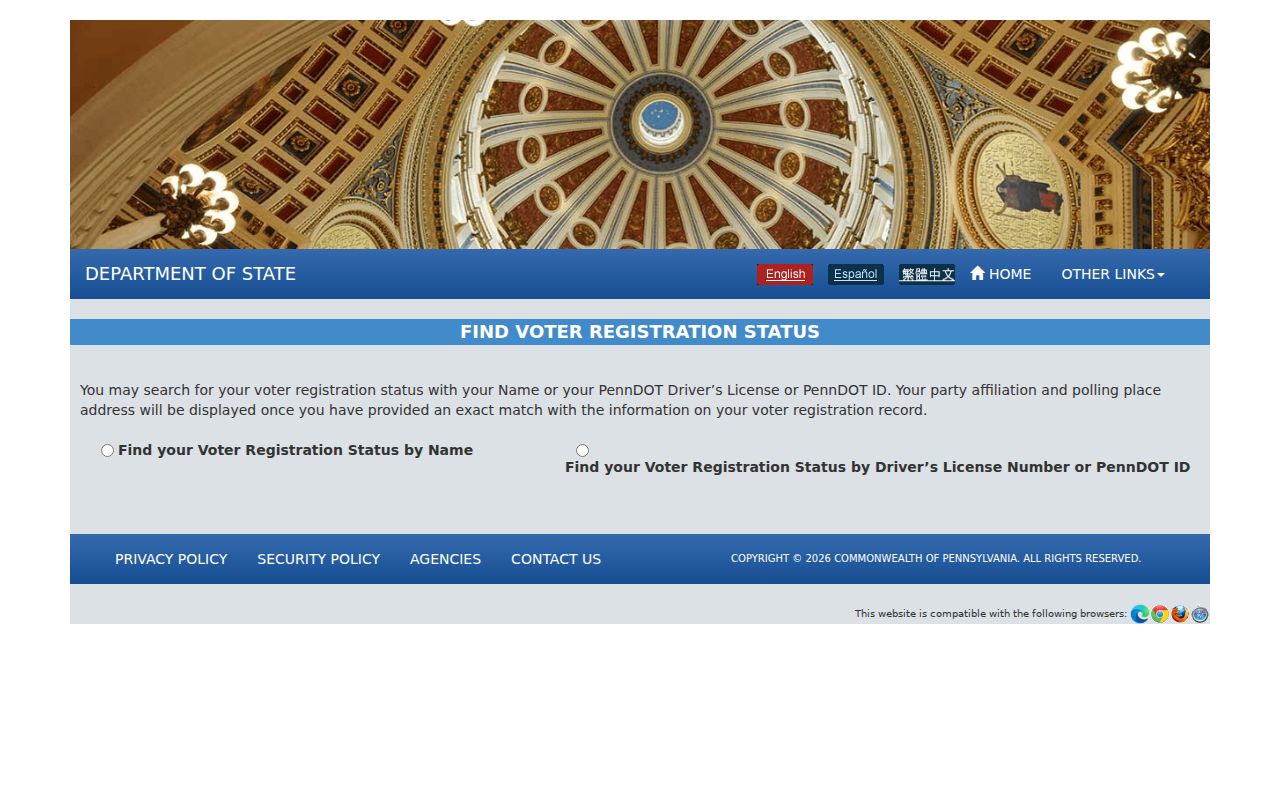
Registration data can change as county processing occurs. An apparent absence is not proof that a person does not live at an address, particularly where protected address-confidentiality arrangements apply.
Lackawanna County Resident RTKL Requests
When an administrative record is not online, Pennsylvania’s Right-to-Know Law, 65 P.S. §§ 67.101-67.3104, is a written-record fallback for county or municipal agencies. Ask the office that created the record first. A request should name the existing document, subject, timeframe, known party or address, and preferred inspection or copy method. The standard form allows a focused description, but an RTKL request cannot override court rules, a sealing order, vital-record controls, or election-record law.
The Office of Open Records standard form includes a 3,000-character record-description field, inspection and copy choices, certification choice, cost-notice option, and PDF attachment route. Agencies generally have five business days to respond, with a timely interim response able to extend the period up to 30 calendar days without agreement. Request a record, not an answer.
Lackawanna County Lookup Boundaries
Public results have firm limits. Juvenile, sealed, expunged, adoption, confidential, and protected court material is not made public by a name search. The Pennsylvania Address Confidentiality Program allows eligible participants to use a substitute address for specified court, state, voter-registration, marriage-license, and other records. A missing or alternate address can be a lawful protection, not a data mistake.
For an error, contact the office that maintains the source record and follow its correction process. Commercial compilations can carry old or mistaken material, so confirmation belongs with the custodian that created the record.