
Lackawanna County Directory Holdings
Historical directory research in Lackawanna County is a collection search, not a promise that every resident appears in one county book. The strongest verified Scranton anchors are the Webb volume and the Historical Society's identified Scranton run. The Scranton Public Library's Albright Memorial local-history collection adds annual volumes, atlases, maps, newspapers, clippings, photographs, family histories, manuscripts, and ephemera. Carbondale has its own route through the Alice Ahern Lynady Room, so a Carbondale address should not be forced into a Scranton-only search.
| Collection | Years | Where Held | Access |
|---|---|---|---|
| Webb's Scranton City Directory | 1876-1877 | Lackawanna Historical Society published research identifies the volume. | Ask the Historical Society or consult a library copy, then verify page and volume. |
| Scranton City Directories | 1902-1985 | Lackawanna Historical Society Library. | On-site research; the county directory reports nonmember library use at $5 per day. |
| Scranton local-history directories and files | Volume-by-volume years not posted | Scranton Public Library, Albright Memorial local history. | Catalog, reference computers, genealogy request route, and copy guidance. |
| Carbondale City Directories | Volume-by-volume years not posted | Carbondale Public Library, Alice Ahern Lynady Room. | Local collection with early newspapers, historical documents, and named databases. |
| Scranton Local History Collection | 1800-present | University of Scranton McHugh Family Special Collections. | Selected materials are digitized; physical materials are browsed by appointment. |
The gaps matter as much as the run. The accessible descriptions do not post an exact annual list for the public-library and Carbondale shelves, and no verified countywide criss-cross run was found. Ask for the years nearest the address or census date, and ask whether that individual volume has a street-order section before assuming it does.
Note: A directory is a publisher's dated compilation, so it is useful household evidence but not proof that someone occupied an address on one exact day.
Lackawanna County Directory Repository Routes
The Lackawanna Historical Society library is the primary named repository for the confirmed Scranton run. The county's directory lists its address as 232 Monroe Avenue in Scranton, with Tuesday through Friday hours of 10 a.m. to 5 p.m. and Saturday hours of noon to 3 p.m. It also lists a $25 base fee for written research inquiries, plus copying charges. The Society's finding-aids page asks researchers to contact it before scheduling access to a specific collection. That call can save a trip when the needed year, surname, map, or manuscript is stored separately.
The Lackawanna County Library System genealogy page points to the Albright collection for Scranton materials and to the Alice Ahern Lynady Room for Greater Carbondale history. Albright's useful adjacent tools include vertical, biographical, and photo indexes. They can identify a name, a place, a former institution, or a local book page that deserves a directory, deed, estate, or newspaper check.
View the Historical Society's library access page before arranging Lackawanna County directory research.
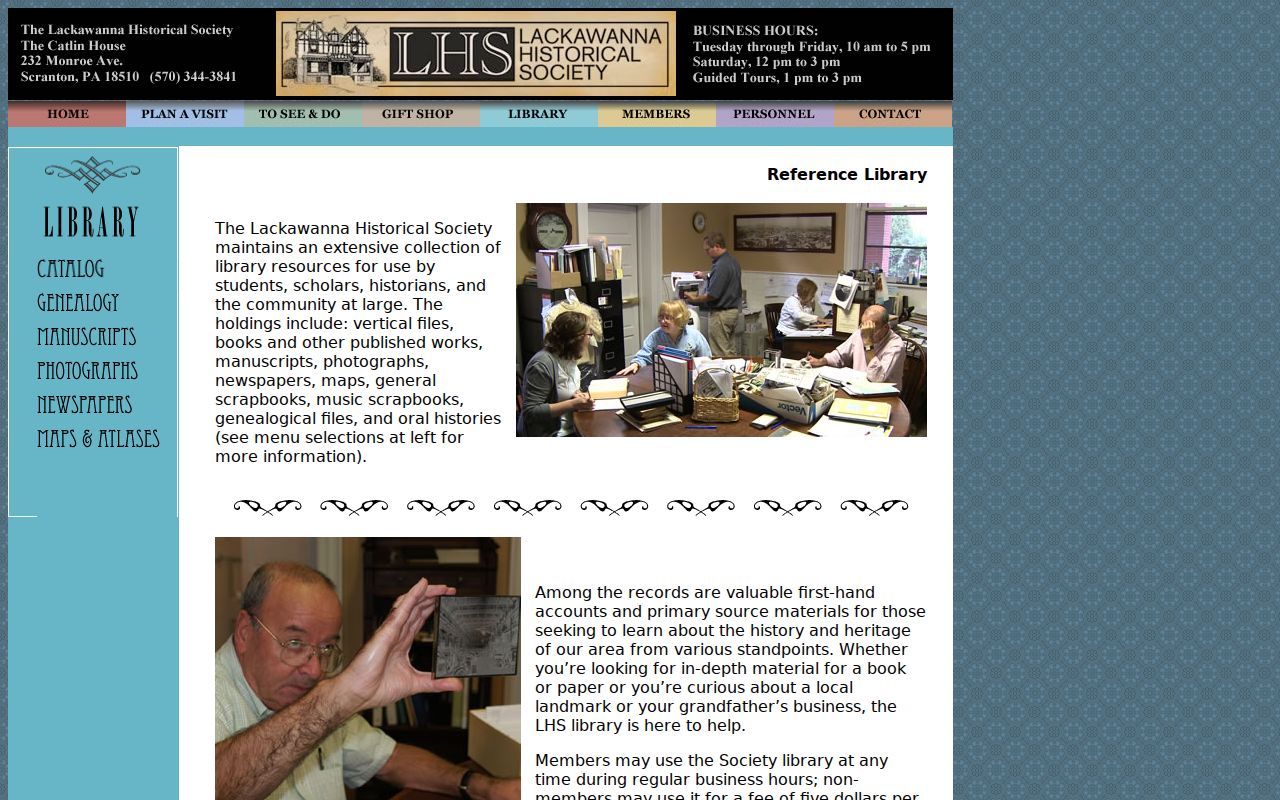
The library's reference setting matches the needed approach: identify a date and place first, then request the particular directory, map, finding aid, or newspaper title that can test it.
Reading Lackawanna County Directory Entries
Copy a local entry as it is printed. The confirmed repositories establish the collections, but accessible repository descriptions did not expose a readable scanned Scranton entry with a local abbreviation key. That means a notation should not be expanded from memory. Capture the name, initials, address, page, year, and any printed line about work, family, boarding, property status, or a cross-reference. A visible 1956 Scranton telephone-directory scan at the Library of Congress pairs name, street address, and telephone number, but it remains a telephone directory rather than a substitute annual-volume citation.
| Printed name | Copy initials, suffixes, alternate spellings, and any cross-reference exactly. |
|---|---|
| Street and place | Record the address plus any ward or borough qualifier printed in that volume. |
| Work or institution line | Keep an occupation, business, or institutional association only when the entry actually prints one. |
| Family or status notation | Preserve spouse, widow, boarding, removal, or property notation only where the volume labels it. |
| Citation details | Save publisher, publication year, page or column, order type, and the abbreviation key. |
- Criss-cross directory
- A street-order or reverse directory, if a particular volume includes one, rather than an assumed countywide feature.
- Householder index
- An index arranged to lead from a printed household name to an entry; confirm that the volume actually supplies one.
- Abbreviation key
- The volume's own explanation of its marks and shortened words. Photograph or transcribe it before interpreting an entry.
Note: A printed occupation or address is a lead to compare with other dated records, not a reason to fill in an unreadable abbreviation.
Lackawanna County Directory Context
The University of Scranton's Scranton Local History Collection spans 1800 to the present and gives a third repository route when a directory needs a map, city-history, parish, institutional, or neighborhood context. Selected materials are available digitally, and the university directs researchers to additional digitized local-history books through Internet Archive. Physical materials are browsed in the reading room by appointment. This is especially useful after a directory produces a date, name variation, or institution worth checking.
View the University collection guide for a Lackawanna County directory companion source.
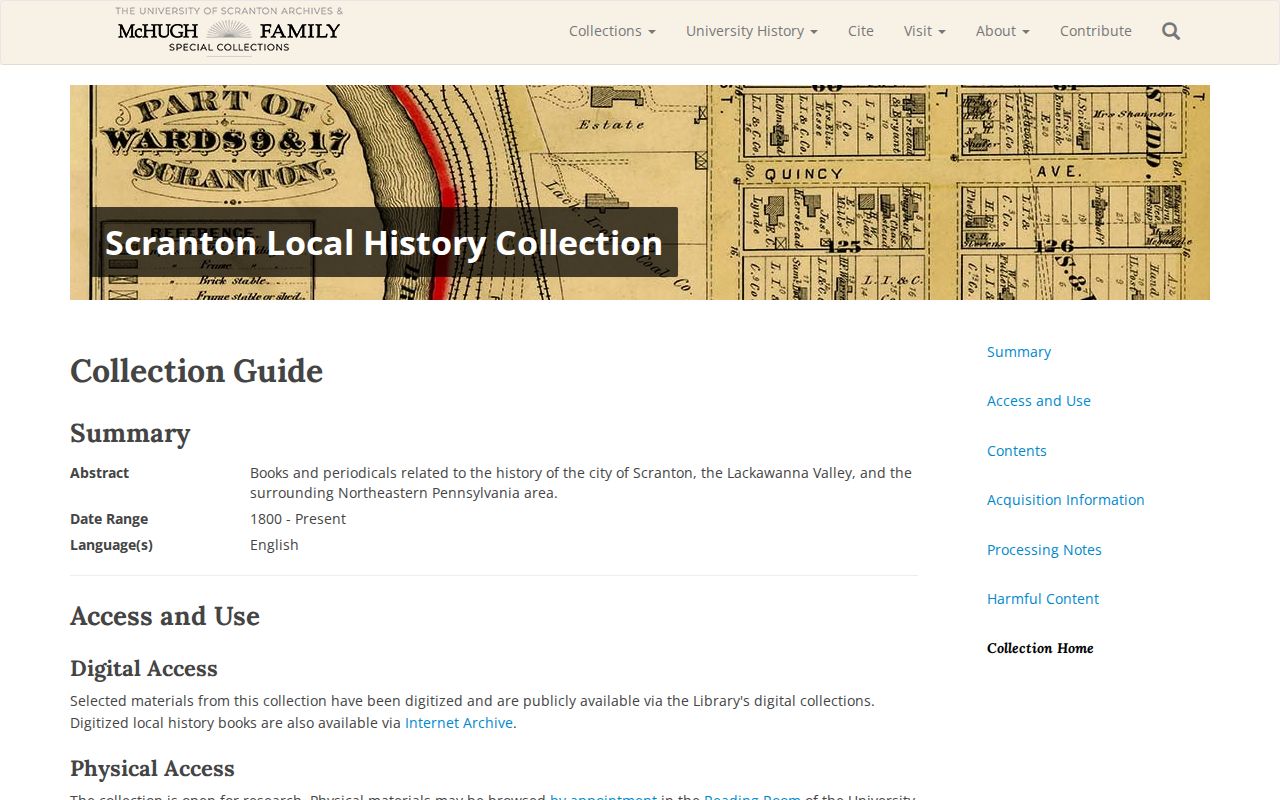
The collection guide's map-centered presentation is a reminder to keep the place and year together. A directory entry may point to a street, while a map or atlas helps determine how that place was described at the time.
Tracing Families in Lackawanna County Directories
A household trail works best when the search starts near a known census, deed, death, or newspaper date. Find the closest available directory, transcribe its full entry, then move one available volume at a time in both directions. Directories provide the in-between address continuity that a decennial census usually cannot. Census records supply household relationships and birthplace fields that directory entries commonly leave out. An address shift should be tested against an old map, atlas, legal description, or later assessment result rather than dismissed as a spelling problem.
- Choose the directory year nearest a known household, property, or census date and copy the entry with its page reference.
- Check the next available volume forward and back, recording address changes, initials, work lines, and cross-references without guessing at their meaning.
- Ask the repository whether the relevant volume has a criss-cross or street section, then use that section only if it is present.
- Pair the directory date with the appropriate census schedule to test household relationships, ages, birthplaces, and address continuity.
- Use a dated newspaper notice, estate record, deed, or map to examine a disappearance, death, transfer, or location change.
A name vanishing from a volume may reflect a move, death, an editorial omission, a new spelling, or an unlisted household. The right response is a nearby year and another record type. For the modern parcel and deed sequence, use the address-based tools on the Lackawanna County by-street directory rather than asking an old printed volume to provide current occupants.
Lackawanna County Directory Timeline
The verified chronology has anchors, not a claim of uninterrupted publication. It begins with the Webb volume, passes through county formation, and includes the Historical Society's identified run. Keep the chronology in view when an address trail crosses the county boundary or changes repositories.
| 1876-1877 | The Webb volume, printed by W. S. Webb & Co., is cited in Historical Society material. |
|---|---|
| 1878 | Lackawanna County formed. Earlier county-era deeds, wills, and naturalization leads can point to Luzerne County instead. |
| 1902-1985 | A federal bibliography identifies the Scranton run in the Historical Society Library for this period. |
| 1800-present | The University of Scranton's local-history collection provides a broad companion collection, with selected items digitized. |
Note: No verified last printed year for every local directory series was found, so a repository should confirm the exact volume before a citation is made.
Newspapers Beside Local Directories
Newspaper microfilm gives a dated check on a directory address. Albright reports an incomplete run of the Scranton Republican from November 1, 1867 through December 24, 1936, specified Scranton Times runs from 1900 through June 24, 2005, and the Scranton Tribune from December 26, 1936 through May 21, 1990. Its listed titles also include the Times-Tribune from June 27, 2005 to the present and other specified runs. Carbondale's local-history branch reports newspapers reaching into the early nineteenth century and digitized local papers available at the library without charge.
Use an obituary, club notice, property transfer, business notice, move notice, or funeral notice as a date test. Such a notice can help distinguish two people with the same name or explain why an address changes between annual volumes. It does not turn a newspaper into a complete resident roll.
Indexes Beyond Local Directories
When no volume lists the expected surname, try the local-history indexes before broadening the claim. Albright describes vertical, biographical, and photo indexes, plus clippings and pamphlets. The Historical Society holds more than 1,300 maps and has finding aids for photographs, maps, manuscripts, land-title material, business collections, funeral-home records, diaries, and organizational papers. These are research leads, not proof that every item is indexed by a person or address.
Scranton's collection policy also highlights coal mining, railroads, ethnic groups, institutions, medical facilities, recreation, government, and local social or cultural records. A colliery, parish, lodge, railroad, hospital, trade group, or neighborhood institution can identify a dated source to compare with a directory line. Preserve the place name as printed, because a postal label, municipality, and repository description may not use the same form.
Lackawanna County Research Before 1878
Lackawanna County's 1878 organization is an important boundary for an early family trail. Before that date, the present territory belonged to Luzerne County for the historical sources described by the Library System. A search that stops at the county boundary should switch custodians rather than assume a household left the area. That is particularly important when a directory date, deed, will, or naturalization record falls near the change.
Scranton's municipal history adds another date check. It was incorporated as a borough in 1856 and as a city in 1866, and the Pennsylvania State Archives identifies digitized city council minutes for 1920-1936. The city label in a historical item may therefore describe a different municipal context than a later county record. Keep the document's printed place, date, page, and repository together when building a family file.
Note: No verified courthouse fire, flood, or general records-loss event was found for this research, so a missing directory entry should not be explained by an invented disaster.